
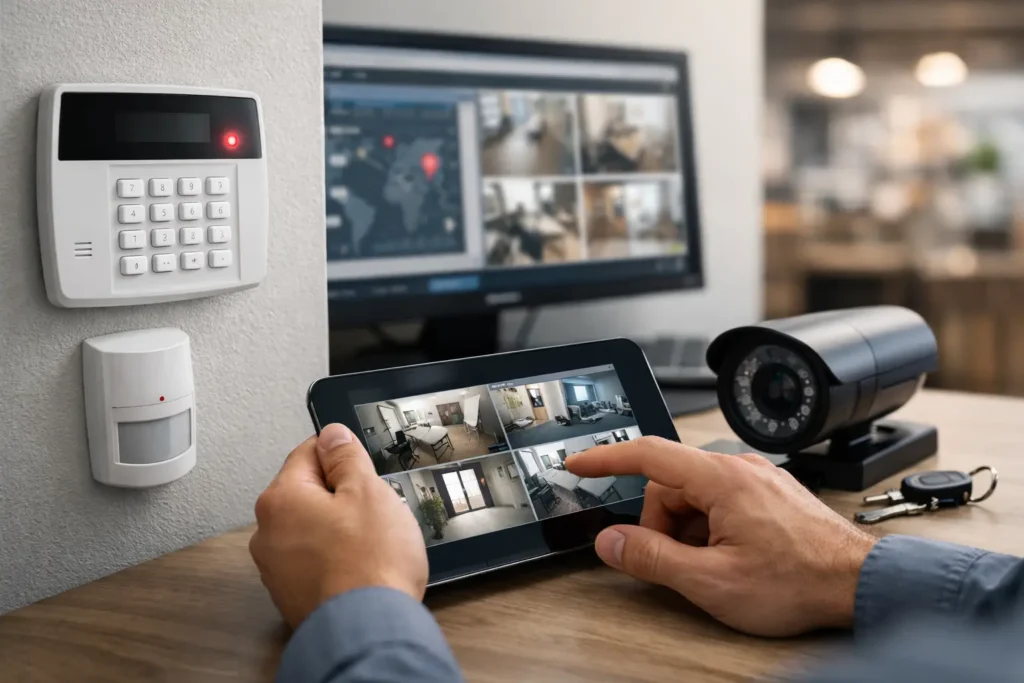
A shop can be empty for only a few minutes before an incident becomes expensive. A rear door left unsecured, an attempted break-in or smoke in a stockroom can quickly affect trading, staff confidence and insurance claims. Alarm monitoring for small business gives those events a defined response, rather than relying on a business owner noticing a mobile phone notification at the right moment.
For many smaller premises, the question is not whether an alarm is worthwhile. It is whether the system has been designed around the building, the risks and the people responsible for it. A monitored alarm should support day-to-day operations without becoming another source of false alerts, call-outs and uncertainty.
What monitored alarm protection actually does
A monitored intruder alarm is connected to an Alarm Receiving Centre, often referred to as an ARC. When the system detects an activation, it sends a signal through a secure communication path. Trained operators assess the information available and follow an agreed response plan.
That plan might involve contacting nominated keyholders, requesting police attendance when the appropriate verification standard has been met, or alerting a security response provider. The exact process depends on the system specification, monitoring package and the instructions set by the business.
This is different from a self-monitored alarm that sends an app notification, text message or call directly to the owner. Self-monitoring can be a sensible option for a low-risk site where somebody is always nearby. It places the responsibility on that person, however, including outside working hours, during holidays and when mobile phone signal or battery life is not dependable.
Professional monitoring adds a human response layer. It does not guarantee that no crime will occur, but it reduces the chance that an activation is missed or left unresolved because a keyholder cannot act.
Why small businesses need a considered approach
Smaller firms often have fewer people available to manage a security incident. The owner may also be the keyholder, facilities manager and person dealing with customers the following morning. That makes a late-night alarm call more than an inconvenience.
Premises vary considerably. A salon may need discreet protection for valuable equipment and a rear staff entrance. A warehouse needs perimeter detection, protection for loading areas and a plan for larger internal spaces. An office with laptops and client information may prioritise access points, server cupboards and out-of-hours access. A restaurant may need the alarm to work alongside CCTV, fire protection and controlled access for deliveries.
The best design starts with these practical questions: what needs protecting, where someone could gain entry, who enters the premises and when, and what action should follow an alarm. Simply adding sensors to every room is not always the answer. Poor placement or unsuitable equipment can create nuisance activations and leave genuine vulnerabilities unaddressed.
Alarm monitoring for small business: the key decisions
Choose the right alarm communication path
A monitored alarm needs a reliable route to send signals. Systems may use broadband, mobile networks or a combination of both. Dual-path signalling, which uses two independent methods, provides greater resilience if a broadband connection fails or is deliberately interfered with.
The appropriate level depends on risk, insurer requirements and the likely consequences of an outage. A single path may suit some low-risk premises, while a business with high-value stock, an isolated location or a history of attempted intrusion may need a higher-grade, dual-path solution. This is an area where the lowest initial price can prove a false economy.
Build verification into the design
False alarms waste time and can reduce confidence in the system. Verified alarm arrangements provide more useful evidence that an incident is genuine before escalation. Depending on the specification, this can involve sequential detector activations, audio verification, CCTV confirmation or a combination of methods.
CCTV integration is particularly valuable when it is designed properly. A monitored alarm activation can prompt cameras to record a relevant area, provide images for verification or allow an operator to understand whether a person is on site. Cameras should not be treated as an afterthought. Their coverage, lighting, storage and network connection all affect how useful they are when an event occurs.
Set realistic keyholder procedures
Monitoring is only as effective as the contact details and instructions behind it. Nominate more than one keyholder where possible, make sure they can access the premises safely, and keep their contact information current. Consider what happens if none of them can attend. A professional keyholding and response service may be appropriate for businesses that do not want staff travelling to site at night.
The response plan should also identify who can authorise reset instructions, who needs to know about an activation and how incidents are recorded. This creates consistency when responsibility changes or a manager is unavailable.
Consider the system as part of the premises
Security works best when the systems communicate intelligently. Access control can show whether a staff member legitimately entered before an alarm activation. CCTV can provide visual context. External lighting can improve camera images and discourage opportunistic access. Networking equipment and Wi-Fi need to be dependable enough to support connected devices without compromising business operations.
For a refurbishment, new fit-out or multi-site operation, planning these elements together is usually cleaner and more cost-effective than fitting isolated systems at different stages. It also gives staff fewer interfaces to learn and makes maintenance more straightforward.
Installation quality affects reliability
An alarm panel and detectors are only part of the solution. Cable routes, detector positioning, power provision, battery backup, signal testing and commissioning determine whether the system performs as expected. Wireless equipment can be highly effective where cabling would disrupt a finished interior, but it still requires careful signal assessment, battery management and appropriate device selection.
A professional installer should survey the premises before recommending equipment. They should consider building layout, vulnerable openings, pets where relevant, environmental conditions, operational hours and future changes to the site. A stockroom that is reorganised, a new partition wall or an expanded office can all affect coverage.
At handover, staff need clear instruction on setting and unsetting, responding to faults and reporting changes. The system should be simple enough to use consistently. If employees find it confusing, they may leave areas unprotected or create repeated false activations.
Maintenance is part of the service, not an optional extra
A monitored alarm needs regular maintenance to remain dependable. Batteries age, sensors can be damaged, communication equipment may need updates, and changes to a building can alter how the system performs. Routine visits and testing help identify these issues before they become a failure during an incident.
Maintenance also provides a useful moment to review whether the design still matches the business. A company may take on a neighbouring unit, introduce higher-value equipment or change its opening hours. Its security requirements should move with it.
When comparing providers, ask who is responsible for installation, monitoring coordination, fault diagnosis and ongoing support. Splitting those responsibilities between several organisations can work, but it can complicate fault resolution. A single specialist team with experience across alarms, CCTV, access control, electrical works and networking can diagnose the wider cause rather than treating each system in isolation.
Questions to ask before committing
Before choosing a provider, establish whether the proposed system is suitable for the premises and whether the monitoring arrangement meets your insurer’s expectations. Ask how alarm signals are transmitted, what happens if the primary connection fails, how false alarms are managed and what the response process looks like at 2am.
You should also understand the ongoing costs. Monitoring, maintenance, SIM connectivity, replacement batteries, call-outs and remote support may be priced differently. A clear proposal distinguishes the upfront installation from the service needed to keep the system effective over its working life.
It is equally worth asking how easily the system can expand. If you add doors, cameras, staff access points or another location, a well-designed platform should accommodate that without requiring a complete replacement.
For businesses across Berkshire and surrounding areas, I-Vizion can design alarm monitoring around the realities of the premises, then support it with integrated CCTV, access control, networking and ongoing maintenance. The aim is not to add technology for its own sake, but to give owners and teams clear control when the building is occupied and dependable support when it is not.
The most useful alarm system is the one your team can operate confidently, your monitoring centre can interpret quickly and your business can rely on long after installation day.


