
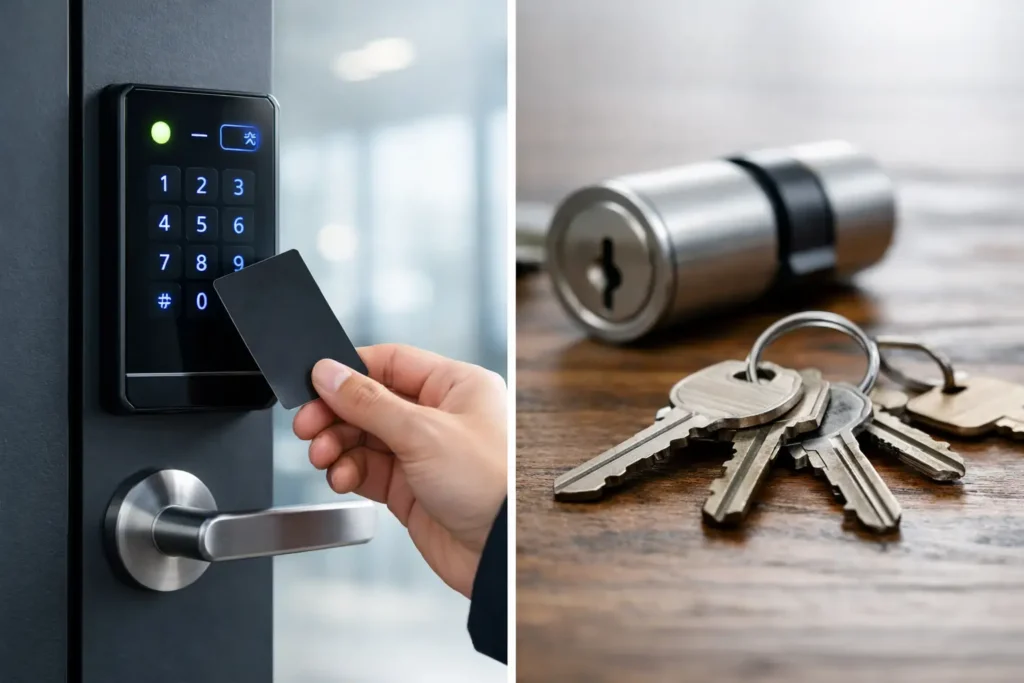
A missing master key can create an immediate security concern. A former employee may still have a copy, a contractor may not return one, or a homeowner may simply be unsure who has had access over the years. The choice between access control vs traditional keys is therefore about far more than how a door opens. It affects security, daily convenience, accountability and the way a property can be managed over time.
For some properties, quality mechanical locks and a disciplined key policy remain the right answer. For others, particularly larger homes, shared buildings and commercial premises, electronic access control offers a more practical level of control. The best choice depends on the people using the building, the doors being protected and how the system needs to operate as the property changes.
Access Control vs Traditional Keys: The Core Difference
Traditional keys rely on a physical object and a mechanical lock. The holder presents the correct key, turns it and gains entry. This is familiar, dependable and requires no network, software or electrical supply at the door.
Access control replaces or supplements the key with a credential. That could be a fob, card, PIN code, mobile phone credential, biometric reader or intercom release. The system checks whether that credential is permitted at that door and at that time. It can then record the event, release the lock and, where required, trigger other systems such as CCTV recording, lighting or alarms.
The distinction is most significant after a credential has been issued. A lost key often means accepting a risk, retrieving every issued key or changing cylinders. A lost fob or phone credential can usually be removed from the system promptly, without changing the hardware on the door. For premises with staff turnover, tenants, domestic help, tradespeople or frequent visitors, that difference has real operational value.
Where Traditional Keys Still Make Sense
Mechanical keys should not be dismissed simply because electronic systems offer more features. A well-specified lock from a reputable manufacturer, correctly fitted to a suitable door, is an effective security measure. It is also straightforward to use, requires little instruction and does not depend on a user having a charged phone or remembering a code.
They can be particularly suitable for a small home with a limited number of trusted occupants, a low-traffic outbuilding or a door where electronic locking would add expense without solving a genuine problem. Cylinders can be keyed alike, allowing one key to operate several doors, while restricted key systems can make unauthorised copying more difficult.
The limitation is control after the key leaves your possession. Key cabinets, sign-out records and restricted key profiles help, but none provides certainty that every copy has been returned. Re-keying is sometimes the sensible response, yet it can become costly and disruptive across multiple doors. Keys also provide little visibility. You may know that a door was opened, but not necessarily who entered or when.
What Electronic Access Control Adds
Access control is designed for properties where permissions need to be managed rather than assumed. An administrator can grant access to an individual, restrict it to selected doors and set time schedules. A cleaner may be authorised on weekday mornings, while a delivery team can be given access to a gated service entrance during an agreed time window.
For a business, this reduces reliance on a shared key ring and makes departures easier to manage. When an employee leaves, their credential can be removed rather than collecting keys and hoping none were copied. Event logs can support investigations, help facilities teams understand building use and create a clearer audit trail for sensitive areas.
In a residential setting, the benefits are often more personal. Homeowners can avoid distributing house keys widely, manage access for gardeners or visiting family, and use an intercom to speak with a caller before releasing a gate or door. When planned as part of a wider smart home installation, access events can also be connected to exterior lighting, CCTV and alarm modes. A gate opening after dark might bring on a driveway light and display the relevant camera on a control panel.
That level of integration should be purposeful. Adding technology simply because it is available can make a system harder to use. The most successful installations keep everyday entry simple while putting advanced control in the background.
Credentials should suit the user
No single credential suits every property. Fobs are familiar and quick to issue, but can still be lost. PIN codes avoid carrying a token, although codes must be changed when they are shared too widely. Mobile credentials are convenient for many users but are less appropriate for everyone, particularly visitors or staff without company-managed devices.
Biometric access can offer strong identity assurance, but it requires careful consideration of privacy, user consent, reliability and the nature of the door being secured. In many cases, a card or fob combined with a PIN provides a sensible balance for higher-security areas.
Security Is About the Whole Door, Not Just the Reader
An access control reader alone does not make a door secure. The lock type, door construction, frame, hinges, glazing, escape route requirements and cable protection all matter. A weak frame or poorly chosen electric release can undermine an otherwise well-designed system.
A professional design starts with the door’s purpose. A main entrance, internal office, plant room, side gate and fire escape each have different requirements. Some doors need an electric strike, others require a magnetic lock or electric locking hardware built into the door. External gates may need intercom integration and appropriate weather protection. Doors on escape routes must be designed in line with fire safety and emergency egress requirements.
Power resilience also deserves attention. Most commercial access systems include battery backup so that authorised operation can continue during a power interruption for an appropriate period. The locking strategy must be selected carefully: a door may need to fail safe, releasing on power loss, or fail secure, remaining locked. Neither is universally better. The correct approach depends on life safety, the security risk and the building’s operational needs.
CCTV can strengthen either approach, but it is especially useful alongside access control. A time-stamped access event paired with video footage provides a much clearer picture than footage alone. This can be valuable at a reception entrance, a warehouse, a shared residential lobby or a high-value storage area.
Cost: Look Beyond the First Installation
Traditional keys usually have the lower initial cost. There is less hardware, no controller or software, and installation can be relatively straightforward where the doors are already suitable. That makes them attractive for smaller projects and uncomplicated access arrangements.
Electronic access control costs more at the outset because it requires readers, locking hardware, controllers, power supplies, cabling and commissioning. Networked systems may also require secure data infrastructure and ongoing software support. However, the lifetime cost can compare favourably where locks would otherwise be re-keyed regularly or where a site spends substantial time administering keys.
The scale of the property matters. On a single-door office or compact home, a full networked system may be excessive. On a multi-door commercial site, a development with shared entrances, or a large home with gates, staff access and separate zones, the administrative savings and additional control can justify the investment.
Maintenance should also be allowed for from the start. Mechanical locks need periodic inspection and occasional cylinder replacement. Electronic systems require testing of locks, backup batteries, emergency release functions, credentials and any connected intercom or network equipment. A system that is installed, documented and supported properly is more likely to remain dependable years after commissioning.
Choosing the Right System for Your Property
The practical question is not whether access control is better in every situation. It is whether the property needs flexible permissions, recorded entry events and easier credential management. If the answer is no, well-chosen mechanical security may be entirely appropriate.
Access control becomes more compelling when there are multiple users, frequent changes in who needs entry, several doors or gates, valuable assets, restricted areas, or a need to connect security with other building technology. It is also an effective option for developers and architects who want a property designed for future use rather than retrofitted under pressure later.
A hybrid arrangement is often the most sensible route. A home may retain conventional high-security locking at certain doors while using video entry and controlled gate access at the perimeter. A business may use keys for low-risk cupboards but electronic access for external entrances, server rooms and staff-only areas. The objective is proportionate security, not technology for its own sake.
For projects across Berkshire and surrounding areas, I-Vizion can assess the building, user routines and wider technology requirements before designing an access approach that fits the property. The design should consider how people enter every day, how they leave safely in an emergency and how the system will be maintained as needs evolve.
Before choosing a solution, walk through a typical week at the property. Consider who needs access, which doors they need, when they need it and what should happen when they no longer do. Those answers will usually point clearly towards traditional keys, electronic access control or a carefully planned combination of both.


