
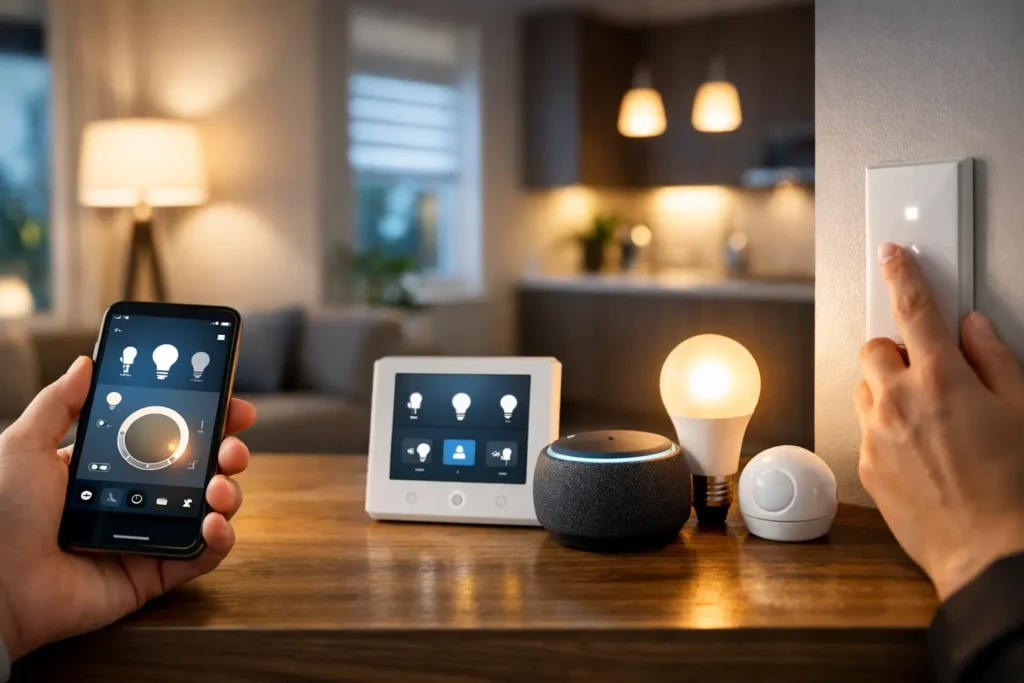
A well-designed room can still feel awkward if the lighting works against it. Too bright for a quiet evening, too dim for cooking, or simply inconvenient when every fitting needs its own switch. The best lighting control ideas solve those everyday frustrations by making light easier to adjust, more responsive to how a space is used, and far more consistent across the property.
For homeowners, that usually means better comfort, cleaner wall finishes, and simpler control. For developers, architects, and commercial clients, it also means energy efficiency, usability, and a system that feels considered rather than added on at the end. Good lighting control is not just about smart gadgets. It is about planning how people move through a space, what they need from it, and how the technology should respond.
What makes the best lighting control ideas worth considering?
The strongest solutions do two things well. First, they improve the day-to-day experience of using a building. Second, they reduce complexity behind the scenes. That might sound contradictory, but it is exactly what a properly integrated control system should do.
A single keypad by the door can replace a bank of mismatched switches. A timed exterior lighting schedule can improve security without anyone needing to remember it. A meeting room can shift from presentation mode to normal use at the press of one button. In each case, the user sees simplicity, while the engineering in the background handles the detail.
There is no single best answer for every property. A period home renovation, for example, may need discreet controls that preserve the interior character. A new-build can be designed around centralised dimming from the outset. A restaurant, office, or retail unit may place greater value on zoning, scheduling, and occupancy response. The right approach depends on the building, the wiring infrastructure, the budget, and how much integration is required with audio visual, heating, security, or blind control.
Best lighting control ideas for homes and commercial spaces
1. Scene-based lighting instead of one-switch thinking
One of the most effective upgrades is scene setting. Rather than turning individual circuits on and off, scenes allow multiple lights to respond together at preset levels. In a kitchen-diner, for instance, you might have separate scenes for cooking, dining, cleaning, and evening use.
This matters because most rooms serve more than one purpose. Open-plan living has made that even more obvious. Scene control gives a space flexibility without asking the user to adjust six dimmers every time the mood changes. It also creates consistency, which is especially valuable in hospitality settings, boardrooms, and reception areas where presentation matters.
2. Occupancy and vacancy sensors in the right places
Sensors are often associated with basic utility spaces, but when used properly they are one of the best lighting control ideas for both convenience and efficiency. In cloakrooms, corridors, plant rooms, storerooms, and back-of-house areas, automatic activation simply makes sense.
The key is to use them selectively. Not every room benefits from motion control, and poor sensor placement can become irritating very quickly. Bedrooms, lounges, and cinema rooms usually need more deliberate manual control. In offices and commercial premises, occupancy logic can be particularly effective when paired with scheduling and daylight adjustment.
3. Layered lighting with separate zones
A single ceiling circuit rarely delivers a good result on its own. Layered lighting divides a room into functional zones such as task lighting, accent lighting, general illumination, and feature lighting. Controlling those zones independently gives much more control over atmosphere and usability.
This is especially valuable in larger homes, extensions, retail spaces, and client-facing commercial environments. It allows the lighting design to support architecture rather than flatten it. It also means the space can adapt throughout the day instead of feeling fixed to one lighting level.
4. App control that supports, not replaces, wall controls
Smartphone and tablet control can be extremely useful, but it should not be the only way to operate a lighting system. The most reliable installations combine intuitive wall keypads with app access for remote use, adjustments, and monitoring.
That balance matters. If a guest, member of staff, or family member needs a mobile phone to turn on the lights, the system has already become less practical than it should be. App control is best viewed as an added layer of convenience rather than the foundation of the user experience.
5. Time schedules for security and routine
Scheduled lighting is often overlooked because it sounds simple, yet it delivers clear value. Exterior lights can activate at dusk and switch off later in the evening. Hallway or reception lighting can follow opening hours. Selected rooms can simulate occupancy when a property is vacant.
For homes, that supports security and routine. For businesses, it helps standardise operation and reduce wasted energy. The trade-off is that schedules need occasional review. Seasonal daylight changes, staff use patterns, and evolving room layouts can all affect what works best.
6. Daylight-responsive dimming
In spaces with generous glazing, lighting does not need to fight natural daylight. Daylight-responsive control adjusts artificial lighting based on the available ambient light, helping maintain comfortable levels while reducing unnecessary output.
This is particularly effective in offices, schools, showrooms, and contemporary homes with large rear extensions or roof lanterns. It can improve efficiency without making the change noticeable to occupants. As always, commissioning is critical. If the calibration is poor, lights may dim or brighten too aggressively, which defeats the point.
The best lighting control ideas often start with better interfaces
The visible part of a lighting control system is the interface, and this is where many projects succeed or fail in daily use. Elegant keypads, engraved buttons, and clearly labelled scene controls are often more valuable than adding another layer of features.
In practical terms, people want certainty. They want to know which button controls the patio lights, which setting prepares the media room, and how to turn everything off when leaving the building. Good interface design removes hesitation. It also helps future-proof the installation because a straightforward control layout remains usable even as other systems are upgraded.
7. Whole-house or whole-building all-off control
An all-off function is simple, but it is one of the most appreciated features once installed. At the front door, bedside, reception exit, or staff lock-up point, a single command can switch off non-essential lighting circuits and leave only selected safety or exterior lights active.
In larger properties, this is less about novelty and more about confidence. No one wants to check every room at the end of the night or after closing up. Where integrated systems are used, this command can also tie into security settings, blinds, or other building functions.
8. Exterior and landscape lighting control
Outside lighting deserves the same level of thought as interior lighting. Paths, entrance areas, terraces, garden features, signage, and car parks all benefit from proper zoning and control. The aim is not to overlight the site, but to improve safety, visual appeal, and usability.
For residential projects, this may mean soft path lighting, feature tree uplighting, and patio scenes for entertaining. Commercially, it often involves practical circulation lighting combined with frontage presentation and security coverage. Weatherproof hardware and correct circuit planning are essential here, as outdoor systems tend to expose weak design decisions quite quickly.
9. Integration with blinds, AV, and security
Some of the best results come when lighting is not treated as a standalone system. In a cinema room, pressing one button can lower lights, close blinds, and start AV equipment. In a boardroom, presentation mode can adjust the lights while preparing displays and audio. In an entrance sequence, lighting can respond alongside alarm settings or access events.
This is where integration adds real value. It reduces the number of separate controls users need to understand and makes the building feel coherent. It also calls for proper design and commissioning. Joined-up systems perform well when they are planned as one solution, not when disparate products are forced together late in the project.
10. Future-ready infrastructure during refurbishment or new build
Sometimes the smartest idea is not a visible feature at all. During renovation or construction, allowing for suitable cabling, panel locations, and control architecture can make a major difference to what is possible later. Even if a client phases the installation, the groundwork can be prepared properly from the start.
This is particularly relevant in larger homes and commercial fit-outs where requirements may evolve. Retrofitting advanced control into a finished building is possible, but it often involves compromises. Early planning gives far better results and tends to protect the client from unnecessary cost later.
Choosing the right lighting control approach
The best system is the one that fits how the property is actually used. A compact family home may benefit most from a few well-planned scenes, exterior scheduling, and straightforward app access. A substantial new-build could justify centralised control with integration across lighting, blinds, heating, and entertainment. A commercial property may prioritise zoning, sensor logic, and dependable operation over decorative features.
That is why lighting control should be treated as part of the wider electrical and technology design, not as a finishing touch. When handled early and specified correctly, it supports comfort, presentation, energy performance, and long-term usability all at once.
In Berkshire and the surrounding area, many residential and commercial projects now expect this level of coordination as standard. The real difference lies in how well the system is designed, installed, and supported after handover. Technology is only useful when it remains dependable in daily life.
If you are considering lighting control, start by thinking less about products and more about behaviour. How should each room feel, what should happen automatically, and where should control be instant and obvious? The answers usually lead to a system that feels quieter, smarter, and much easier to live with.


