
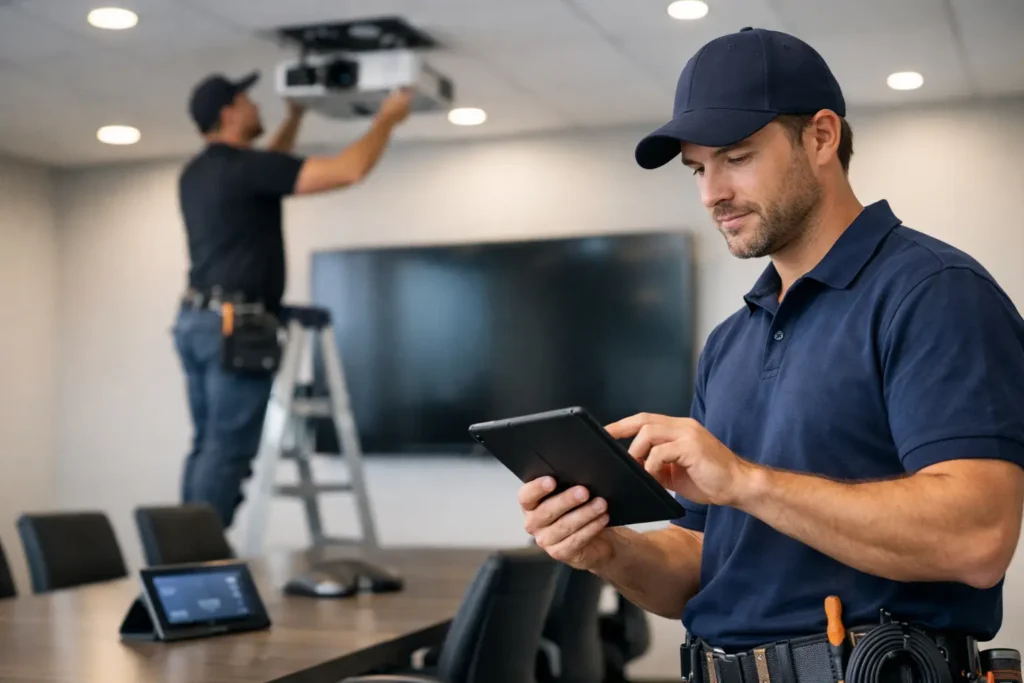
A boardroom that looks impressive on handover day can still become a daily frustration if the sound drops out, the screen-sharing fails, or no one knows which button to press. That is the reality of commercial AV installation. It is not just about fitting displays, speakers and control panels. It is about creating a system that works reliably in real conditions, for real people, every single day.
For businesses, AV now sits much closer to core operations than many projects allow for. Meeting rooms need to support hybrid working without awkward delays. Reception spaces need digital signage that is clear, well positioned and easy to update. Training rooms need speech intelligibility, not just volume. In customer-facing environments, presentation quality shapes perception of the brand long before any conversation starts.
What commercial AV installation really involves
A proper commercial AV installation starts well before equipment arrives on site. It begins with understanding how a space will be used, who will use it, and what has to happen without fail. A small meeting room used for internal calls has different demands from a divisible conference suite, a school hall, a retail environment or a hospitality venue.
That early design stage matters because AV systems are affected by the room itself. Ceiling height, wall finishes, glazing, ambient light, background noise and furniture layout all change the result. A large display in the wrong place can be unreadable by mid-afternoon because of glare. A good speaker system can still sound poor if reverberation has not been considered. A microphone choice that looks sensible on paper may be wrong for a room with flexible seating.
This is why experienced installers look beyond product specifications. They consider signal flow, cable routes, power provision, network capacity, rack locations, ventilation, control logic and future service access. The goal is not simply to make the system work on day one. It is to make it dependable, maintainable and straightforward to use.
Why the design phase saves time and money
AV problems often appear later because the design work was rushed. A business may choose screens before deciding what content will be shown, or select a conferencing platform without checking whether the room acoustics support clear speech. In new builds and refurbishments, AV is sometimes treated as a final fit-out item when it should be coordinated alongside electrical, data and interior design from the start.
Good planning reduces compromises. It allows cabling to be concealed neatly, floor boxes to be placed correctly and equipment cupboards to be sized properly. It also helps avoid the false economy of buying hardware that then needs adaptors, workarounds or replacement. The cheapest display or speaker is rarely the least expensive option over the life of the system if it creates support calls, user confusion or poor performance.
There is also a practical point around business disruption. When AV has been designed properly, installation can be phased around working hours, other trades and site access. That means fewer delays and fewer last-minute decisions under pressure.
The systems around the system
Commercial AV rarely stands alone. It usually connects with the wider building technology. Displays may rely on structured cabling and network switches. Control interfaces may need to interact with lighting scenes, blinds or occupancy settings. Background audio in one area may need to mute automatically when an announcement is made elsewhere. Access control and CCTV may share containment routes or comms infrastructure.
This is where integration experience becomes valuable. A provider that understands electrical installation, networking and control systems can plan the project as a whole rather than as a collection of separate packages. That tends to produce a tidier result and a clearer line of responsibility if issues arise later.
Choosing the right commercial AV installation for the space
There is no single best AV setup for every business. It depends on the space, the users and the level of operational risk if something fails.
In a straightforward huddle room, a high-quality display, camera, microphone and simple touch control may be enough. The priority is usually ease of use. Staff should be able to walk in, start a meeting quickly and trust the room to behave consistently.
A boardroom is different. The image and audio quality matter, but so does presentation. Cable management, furniture integration and discreet hardware all carry more weight. Senior teams and visiting clients will notice if the room feels clumsy to use or visually untidy.
Training spaces and classrooms place heavier emphasis on speech clarity, visibility from multiple seating positions and flexibility. Hospitality and retail environments focus more on atmosphere, zoning and content management. Warehouses and industrial sites may care less about aesthetics and more about durability, audibility and reliable coverage.
The point is simple. Good AV design follows use case first, hardware second.
What businesses often underestimate
One of the most common mistakes is assuming users will adapt to a complicated system. They rarely do. If starting a video call takes six button presses and a bit of guesswork, people will avoid the room or use it badly. The most successful systems are often the ones that feel almost invisible because they make routine tasks easy.
Another overlooked factor is support. Even well-designed systems need updates, occasional troubleshooting and sometimes user guidance after handover. A business that depends on meeting rooms, digital signage or presentation areas should think beyond installation and consider maintenance, monitoring and response times. A fault in a client presentation space can have commercial consequences very quickly.
Scalability matters too. A company may begin with one or two AV-enabled rooms and then add more spaces, more screens or more sites. If the first installation has no thought for standardisation, future expansion becomes expensive and inconsistent. It is usually worth agreeing control principles, preferred platforms and support arrangements early, especially for multi-room or multi-site estates.
Cabling, power and network provision
The visible parts of an AV system get most of the attention, but the hidden infrastructure often determines whether the installation is genuinely professional. Poor cable management, undersized containment, limited power provision and weak network planning can all undermine performance.
For example, digital signage may need resilient network connections and properly protected power supplies if uptime is important. Video conferencing systems may struggle on congested networks. Equipment racks need ventilation and access for service. Wireless presentation can be convenient, but it still relies on dependable underlying infrastructure.
These are not glamorous decisions, but they shape day-to-day reliability. Businesses usually notice the quality of infrastructure only when it is missing.
The value of commissioning and user handover
Installation is not complete when the screens switch on. Proper commissioning checks that sources route correctly, audio levels are balanced, microphones are tuned, control interfaces behave as expected and the whole system performs under realistic conditions. That includes testing with actual users where possible, not just engineers.
Handover is equally important. Staff need clear, concise guidance tailored to how they will use the space. This does not mean overwhelming them with manuals. It means making routine tasks obvious and ensuring someone knows what to do if there is a problem.
For commercial clients, this stage often marks the difference between a system that becomes part of normal operations and one that attracts constant complaints.
When a bespoke approach matters most
Not every project needs a highly customised AV solution. Some rooms benefit from a standardised, repeatable design that keeps operation simple and support efficient. But bespoke design becomes more valuable when the space is architecturally complex, client-facing, multifunctional or part of a wider integrated environment.
In those cases, a tailored approach can solve issues that standard packages cannot. That might mean coordinating AV with lighting control, hiding equipment within joinery, planning audio zoning across multiple areas, or designing for a building where aesthetics are as important as technical performance. For businesses in Berkshire and surrounding areas carrying out premium fit-outs, this level of detail often makes a noticeable difference to both usability and finish.
A specialist integrator such as I-Vizion can also provide continuity from design through installation, commissioning and ongoing support. That joined-up responsibility helps keep projects moving and gives clients one experienced point of contact rather than several disconnected contractors.
What good looks like after handover
The best commercial AV installation is rarely the one people talk about most. It is the one that supports meetings without delay, presents content clearly, sounds natural in the room and can be relied on under pressure. It fits the space, matches the organisation’s working style and remains serviceable as needs change.
That takes technical skill, but it also takes restraint. Not every room needs every feature. In some cases, reducing complexity is the smartest design choice. In others, investing more upfront avoids years of inconvenience and patchwork upgrades. The answer depends on the room, the users and the cost of getting it wrong.
If you are planning AV for a workplace, retail space, education setting or hospitality venue, start by asking how the system needs to perform on an ordinary Tuesday morning, not just how it should look on installation day. That question usually leads to better decisions.


