
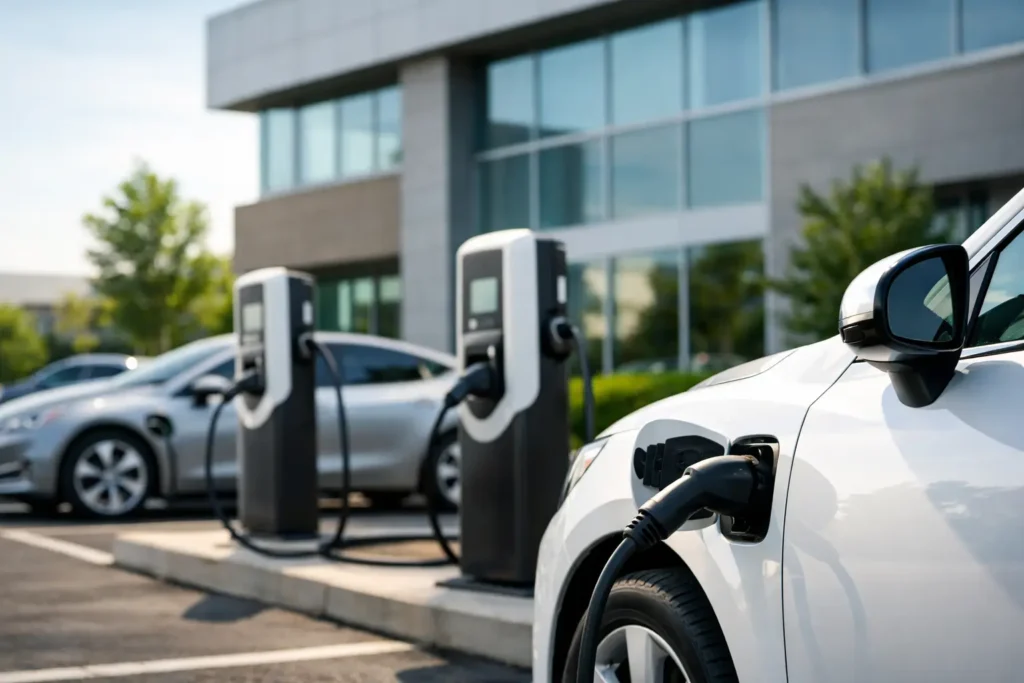
A row of chargers in a car park can look like a straightforward addition. In practice, EV charging for commercial premises is an electrical infrastructure project that affects available power, parking arrangements, user access, operating costs and future development plans. Get the design right at the outset and charging becomes a practical amenity for staff, visitors, tenants or fleet drivers. Get it wrong and a site can be left with slow chargers, avoidable disruption and costly remedial work.
For commercial decision-makers, the objective is rarely to install the greatest number of charge points immediately. It is to create a safe, well-managed system that serves real demand now and can grow without rebuilding the entire installation later.
Planning EV charging for commercial premises
The first decision is not the charger model. It is who will use it and when. An office with employees parked for eight hours has different requirements from a retail destination where drivers may stay for 45 minutes. A hotel, managed residential development, industrial estate and delivery depot each have their own charging patterns, access requirements and expectations around payment.
Workplace charging often suits lower-power AC units because cars have time to charge while their owners work. Visitor spaces may justify faster charging where dwell time is shorter. Fleet operations need a more detailed assessment of vehicle battery sizes, return-to-base times, route schedules and the consequences of a vehicle leaving without enough charge. Faster is not automatically better: high-power equipment can require more available capacity, a larger budget and more complex electrical works.
A considered site survey should establish the practical constraints before equipment is specified. This includes the incoming electrical supply and spare capacity, the route from the distribution board to parking bays, ground conditions, lighting, drainage, parking circulation and mobile or network signal. It should also consider whether the selected locations will remain convenient when the site changes over the next five to ten years.
In many cases, the charger itself is only one part of the investment. Trenching, ducting, reinstatement, protection bollards, new distribution equipment and network connections can have a greater influence on programme and cost. Identifying those elements early produces a more accurate budget and avoids surprises once work begins.
Design for the people using the site
The user journey should be as deliberate as the electrical design. Employees may need controlled access through a card, app or building credential. Visitors may require a clear public payment process. Tenants in a multi-occupied building may need individual billing, while a business with company vehicles may prefer charging to be recorded against departments or drivers.
Parking bay placement matters too. Chargers need to be accessible without creating cable trip hazards, blocking pedestrian routes or causing drivers to reverse awkwardly around buildings. Good signage, sensible bay markings and appropriate protection from vehicle impact help the installation remain orderly and dependable long after commissioning.
For sites already using access control, CCTV or smart building systems, there is an opportunity to coordinate the experience. Authorised users can be managed more effectively, charging areas can be monitored, and faults can be identified promptly. Integration should be useful rather than complicated: the aim is clear oversight for facilities teams and a simple process for drivers.
Start with electrical capacity, not assumptions
Electrical capacity is the central technical question. A site may appear to have adequate supply on paper, but existing demand from air conditioning, machinery, kitchens, lighting or future tenant fit-outs can leave little headroom at peak periods. Installing several chargers without understanding the load profile can lead to expensive supply upgrades or unnecessary restrictions on charging.
Load management provides an alternative in many circumstances. Rather than allowing every charge point to draw maximum power at once, an intelligent system monitors building demand and shares available power between vehicles. Charging may slow temporarily when the building is under heavy load, then increase again when demand falls. For a workplace where vehicles remain parked for several hours, this is often a sensible trade-off between user convenience and capital cost.
Dynamic load balancing also makes phased installation more practical. A business can install containment and electrical infrastructure for a larger future rollout, while fitting only the number of charge points needed today. When demand rises, additional units can be added with less disruption to the car park and less risk of reopening finished surfaces.
That said, load management is not a substitute for proper planning. A fleet that requires predictable rapid turnaround may need dedicated capacity rather than a shared arrangement. The appropriate solution depends on the operational consequences of delayed charging, not simply the number of vehicles on site.
Choose chargers around dwell time and operating needs
Most commercial installations use AC charging for staff, tenant and destination parking. It is well suited to longer stays and can be deployed at a manageable scale when paired with intelligent energy management. DC charging provides a faster option but requires considerably more electrical capacity and usually has a stronger case where drivers need to continue their journey quickly.
The decision should also account for vehicle compatibility and cable arrangements. Tethered units can be convenient for visitors, while socketed units may suit controlled workplace environments. Equipment should be selected from established manufacturers with clear maintenance arrangements, appropriate warranty support and reliable back-office management.
Avoid specifying equipment solely on headline charging speed or purchase price. A charger that is difficult to manage, incompatible with the desired payment model or poorly supported can become an ongoing facilities issue. Commercial charging should be treated as an operational service, not a one-off purchase.
Safety, compliance and installation quality
Charge points are high-demand electrical devices installed in exposed, vehicle-accessible locations. Correct design, protective measures, earthing arrangements, cable sizing and testing are fundamental. The installation must be planned and completed in line with current UK electrical requirements, manufacturer instructions and the conditions of the particular site.
An experienced electrical contractor will assess the existing installation rather than assuming it is suitable. They will also consider isolation, protection against impact, weather exposure, cable routes and safe access for future inspection or repair. In older commercial buildings, an initial electrical inspection may reveal upgrades needed before EV equipment can be added safely.
Commissioning is equally important. Each charger should be tested, configured, labelled and handed over with clear information for the people responsible for the site. Facilities teams need to know how to authorise users, respond to common alerts, report faults and arrange support. Drivers need instructions that are concise enough to use at the point of charging.
Make billing and management proportionate
Not every business needs a complex commercial charging platform. A small office may simply want to offer free charging as an employee benefit, with reasonable controls to prevent spaces being occupied all day. A landlord or customer-facing venue may need tariff setting, payment processing, usage reports and separate billing for different users.
The right management platform should provide visibility without creating administrative burden. Useful features include live charger status, session history, remote diagnostics, user permissions and energy reporting. Where charging costs are passed on, transparent pricing and clear parking rules help prevent disputes.
Connectivity deserves attention during planning. Some charge points rely on mobile signal, while others can use wired network infrastructure or local Wi-Fi. A weak or unreliable connection can limit remote management and payment functions, so it should be tested rather than assumed. For businesses investing in wider data networking, security or access-control improvements, coordinating these works can reduce repeat visits and disruption.
Build a system that can grow with the property
EV adoption does not follow a fixed timetable. Demand may rise quickly after chargers become visible, particularly where employees can charge during the working day or a landlord wants to attract higher-value tenants. The most cost-effective response is usually to make the first phase expansion-ready.
This can mean installing larger ducts, spare ways in distribution equipment, capacity for future load management, or a cable route to areas of the car park not yet being used. These measures cost far less during initial groundworks than after landscaping, surfacing and parking layouts are complete.
A phased approach also protects the budget. It allows a business to review utilisation, user feedback and electrical demand before committing to the next stage. The initial design must still have a coherent end state, so that future additions operate as part of one managed system rather than a collection of unrelated chargers.
For Berkshire businesses and property managers, a specialist team such as I-Vizion can bring together electrical design, data connectivity, access control and ongoing support under one coordinated scope. That matters when the charger installation has to work alongside the wider technology and security infrastructure of an active site.
The best commercial charging installations are rarely the most conspicuous. They are the ones drivers can use confidently, facilities teams can manage easily and property owners can expand sensibly when demand changes. Start with the building, the people who use it and the power available – then select the charging equipment to suit.


