
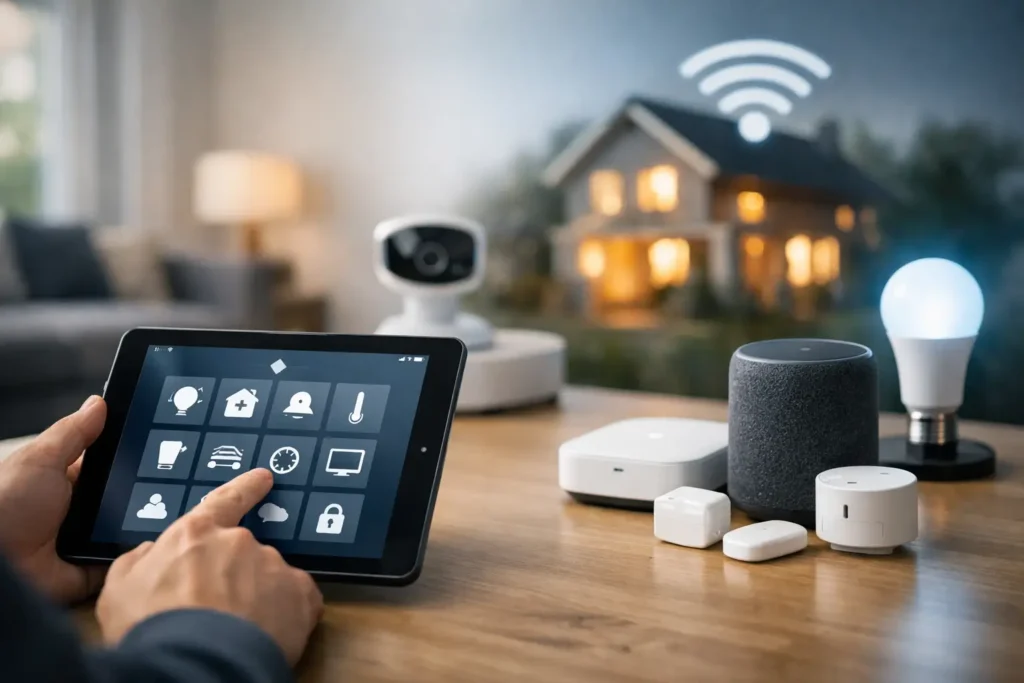
Choosing a smart home platform often looks simple until the first compromise appears. The lighting app works well, but not with the heating. The alarm is reliable, but separate from the cameras. Voice control sounds attractive, yet the system still needs three different interfaces for day-to-day use. A proper home automation platform review should cut through that confusion and focus on what actually matters once the installation is live and part of everyday life.
For homeowners, developers and commercial clients, the platform is not just another app. It is the control layer that determines how lighting, heating, audio visual systems, blinds, security, access control and networking work together. Get that decision right and the building feels intuitive. Get it wrong and even good equipment can feel disjointed.
Why a home automation platform review needs to go beyond features
Most comparisons start with feature lists. On paper, that seems sensible. In practice, feature count rarely tells you how well a platform will perform in a finished property. A system may support hundreds of devices, but still be awkward to use, difficult to maintain or limited when the project grows.
The better question is whether the platform suits the building, the people using it and the level of integration required. A renovated family home has different demands from a new-build development. A private cinema room, whole-house lighting scenes and gate access control create a different brief from a flat with a few smart speakers and thermostats.
That is why platform selection should be led by design intent rather than gadget appeal. A good installer will look at how the building is used, where reliability matters most and how future upgrades are likely to be handled.
The main types of home automation platform
Broadly speaking, platforms fall into three groups. There are consumer-first systems built around convenience and low entry cost. These are often fine for individual rooms or smaller setups, but they can become fragmented as more subsystems are added.
Then there are dedicated smart home platforms designed for custom installation. These usually offer deeper control over lighting, AV, climate, security and user interfaces. They are more suitable where performance, consistency and whole-property control matter.
Finally, there are more specialist or hybrid approaches, where a platform is chosen around one core strength such as lighting control or advanced custom logic, then integrated with other systems around it. This can be highly effective, but it requires careful planning and experienced commissioning.
None of these approaches is automatically best. It depends on the property, the budget, the complexity of the brief and the level of aftercare expected.
Home automation platform review criteria that matter most
Reliability beats novelty
Reliability should sit at the top of any serious evaluation. If lighting scenes fail intermittently or security notifications arrive late, confidence in the whole system disappears very quickly. The best platforms are not necessarily the ones with the flashiest marketing. They are the ones that respond consistently, recover well after power or network interruptions and remain stable over time.
This is especially important in larger homes and commercial settings, where automation is tied to comfort, safety and day-to-day operation. A platform that depends too heavily on cloud services may be acceptable for non-critical convenience features, but less suitable where local performance is essential.
Integration quality is more important than device count
Many platforms claim compatibility with a long list of brands. That sounds reassuring, but compatibility is not the same as meaningful integration. In some cases, a device can be added, yet only basic on and off control is available. In others, advanced settings, feedback or scene participation may be missing.
A worthwhile review looks at how deeply the platform integrates lighting, HVAC, audio visual, CCTV, alarms, gates and shading. Can those systems trigger each other intelligently? Can the user control them from one clear interface? Can the installer programme sensible actions without creating a fragile workaround?
User experience should be simple, not simplistic
A platform can be technically excellent and still frustrate users if the interface is poor. Good automation should reduce effort. It should not require household members, guests or staff to learn complicated sequences just to adjust lights or arm the alarm.
The strongest platforms allow for straightforward control on touch panels, phones, keypads and, where appropriate, voice. More importantly, they present the right level of control in the right place. Everyday actions should be immediate. More advanced settings should still be available, but not clutter the experience.
Support and maintenance are part of the product
This point is often missed. In real projects, the value of a home automation platform is shaped as much by support as by specification. Software updates, device replacements, network changes and property alterations all affect performance over time.
A platform backed by experienced design, installation and maintenance support will usually provide better long-term results than a cheaper system assembled from separate parts with no clear ownership. When one specialist can diagnose faults across power, data, AV and automation, issues are resolved faster and with less disruption.
Where popular platform approaches succeed and struggle
Consumer ecosystems are attractive because they are accessible and familiar. They often work well for straightforward music control, smart plugs, video doorbells and a small number of connected devices. The trade-off is that they are rarely ideal for complex lighting schemes, mixed-brand integration or properties where hardwired reliability is preferred.
Installer-led platforms tend to perform better in larger homes, renovation projects and premium developments. They are designed to unify multiple systems with a consistent interface and dependable control. The trade-off is higher upfront planning and installation cost, which makes little sense if the brief is modest.
More specialised systems can be excellent when the project has a clear technical priority. For example, a lighting-led scheme may deliver exceptional atmosphere and convenience, especially when linked properly with AV, heating and security. The trade-off is that the overall experience depends heavily on the quality of system design and commissioning.
This is where a bespoke approach matters. A platform should fit the project rather than the project being forced to fit the platform.
What different clients should prioritise
For homeowners
Homeowners usually benefit most from simplicity, reliability and elegant everyday control. If the aim is to manage lighting, heating, entertainment and security from one place, the platform must feel natural to use by everyone in the house. It should also be flexible enough to adapt if a cinema room, garden audio or electric gate control is added later.
For developers and architects
Developers and design professionals often need repeatable performance, tidy integration and a solution that adds value to the property rather than unnecessary complexity. The right platform should support clean installation, dependable commissioning and a finish that complements the wider design intent. Scalable support also matters, especially if multiple units or phased works are involved.
For commercial clients
Commercial projects tend to place greater emphasis on resilience, access management, networking, AV functionality and ongoing service support. Ease of use still matters, but so do permissions, maintenance response and the ability to integrate practical systems such as CCTV, alarms and entry control into a coherent whole.
Questions worth asking before you choose
A useful home automation platform review should leave you with better questions, not just a favourite brand. Ask whether the platform works locally or depends mainly on the cloud. Ask how it handles lighting, security and AV together rather than in isolation. Ask what happens when the network changes, when devices need replacing or when the property is extended.
It is also worth asking who will support the system after handover. That answer often reveals more than the brochure. In many cases, the long-term success of a smart building comes from the quality of design, installation and aftercare as much as the underlying hardware and software.
For clients in Berkshire and the surrounding area, that local support can be particularly valuable when projects involve multiple trades, staged upgrades or high-specification finishes where careful coordination matters.
The real measure of value
The best platform is not the one with the longest feature list. It is the one that makes the building easier to live in, easier to manage and more dependable over time. That could mean discreet lighting scenes that respond exactly as expected, a single interface for music and cinema control, or security systems that work without fuss when you are away.
At I-Vizion, this is why platform choice is treated as part of a wider integration strategy rather than a stand-alone purchase. The aim is not to fill a property with technology for its own sake, but to create a system that feels considered, reliable and properly supported.
If you are comparing platforms, look past the app screenshots and product claims. The right question is simple: which solution will still feel right after the novelty has worn off and the building needs to perform every day?


