
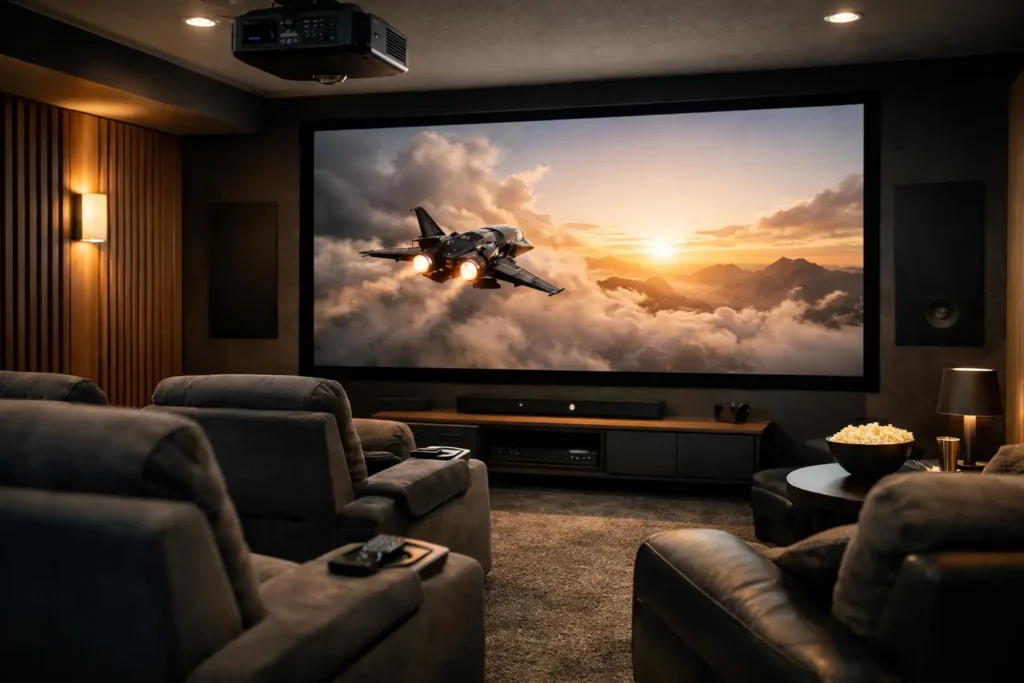
A successful cinema room is not defined by the size of its screen or the number of speakers on display. It is defined by how consistently it performs when the lights are down, the family is settled, and a film begins. This home cinema design guide focuses on the decisions that shape that experience: the room itself, acoustic control, display choice, lighting, control and the infrastructure behind it all.
For a new build or major renovation, cinema planning should begin before first-fix electrical and plastering work. Retrofitting is entirely possible, but early coordination gives far greater freedom over speaker positions, cable routes, ventilation and finishes. It also avoids the familiar compromise of having excellent equipment constrained by a room that was never prepared for it.
Start with the room, not the equipment
A dedicated cinema room gives the greatest control over sound and light, but it is not the only route to an excellent result. A converted garage, loft room, basement, garden room or carefully designed living space can all work well. The key question is how the room will be used. A family media room needs flexible lighting, accessible control and equipment that remains discreet. A dedicated theatre can prioritise darkness, acoustic isolation and cinema-style seating.
Room proportions matter. Square rooms and rooms with matching dimensions can exaggerate certain bass frequencies, making dialogue unclear or low-end effects uneven from seat to seat. This does not automatically rule a room out, but it makes acoustic design more important. Ceiling height also affects where a projector, speakers and acoustic treatments can be placed.
Plan the seating position before selecting the screen. The distance from the main seats to the screen determines comfortable screen size, while the viewing angle affects whether a film feels involving or tiring. It is sensible to leave circulation space around seating too. A cinema room should feel relaxed when guests enter and leave, rather than becoming a row of chairs pressed tightly against the walls.
Home cinema design guide: picture choices
The choice between a television and projector depends on the room, expected use and visual preference. A large premium television offers impressive brightness, sharpness and day-to-day simplicity. It is often the strongest option for multi-purpose rooms where daytime viewing, sport and gaming are priorities.
A projector and projection screen can deliver a more cinematic scale, particularly in a dedicated, light-controlled space. However, projection demands more from the design. Ambient light must be managed, projector placement must be accurate, and the screen surface should be selected for the room’s lighting conditions. A projector that performs beautifully in a darkened room may look flat in a bright open-plan area.
Screen location should be considered alongside speaker placement. If front speakers sit behind an acoustically transparent screen, the sound can appear to come directly from the action, just as it does in a commercial cinema. This arrangement needs sufficient depth behind the screen and careful specification, but it can produce a notably more convincing result.
Do not overlook content sources and signal distribution. Streaming services, satellite, games consoles and media players all need a reliable route to the display and audio system. Where equipment is stored remotely in a rack or cupboard, suitable cabling and signal management prevent the room from becoming cluttered with boxes, power supplies and visible leads.
Sound needs engineering, not just more speakers
Surround sound is where many installations succeed or fail. Speaker quantity alone does not create immersion. Positioning, calibration and room acoustics have equal influence on the final result.
A properly designed system places the centre speaker where dialogue is clear and anchored to the screen. Left and right speakers create width and movement, while surround and height channels add the detail that makes rain, aircraft, music and effects feel convincingly placed around the audience. Subwoofers provide impact, but they also need careful positioning and tuning to avoid boomy bass in one seat and weak bass in another.
In-wall and in-ceiling speakers offer a clean finish and can be highly effective when selected and installed correctly. They are not automatically the best answer for every room. Freestanding speakers may offer greater enclosure volume and performance, while architectural speakers can be the better choice where interior design and clear floor space are essential. The right solution depends on the room and the listening expectations, not a fixed equipment list.
Acoustic treatment is often misunderstood as covering walls with foam. Effective treatment is more considered. It may include absorption at key reflection points, bass control in corners, diffusion to maintain a natural sense of space, acoustic doors and upgraded wall construction to reduce sound transfer. The aim is not to create a dead room. It is to reduce unwanted reflections and resonance while keeping sound detailed, dynamic and comfortable.
Control light from the first drawing
Light is one of the biggest influences on picture quality and atmosphere. Even a very capable display struggles against glare, reflections and daylight falling directly across the screen. Blackout blinds, curtains or shutters are particularly valuable in rooms with large windows, while darker wall and ceiling finishes can minimise reflected light in dedicated cinema spaces.
Lighting should be layered rather than reduced to one central fitting. Low-level step lights improve safety without distracting from the film. Dimmable wall lights or ceiling circuits can create an inviting pre-show setting, and subtle LED lighting around joinery can provide useful orientation when the screen is off. All lighting must be dimmable in a way that avoids flicker and works reliably with the chosen control system.
Scene-based control makes the room easier to use. One button can lower blinds, dim lights, power the system and select the right source. A pause scene can raise lights gently without flooding the room, while a cleaning scene can bring the entire space to full brightness. This is not a novelty feature. It removes the friction that otherwise makes a sophisticated system feel complicated.
Make the technical infrastructure invisible and serviceable
A clean installation depends on what is hidden behind walls and inside cupboards. Dedicated electrical circuits, correctly sized containment, ventilation, data cabling and labelled connections all protect performance and make future maintenance far simpler. Audio-visual equipment generates heat, particularly amplifiers, processors and network switches. A beautiful cabinet without adequate ventilation can shorten equipment life and cause intermittent faults.
Network reliability also matters more than many homeowners expect. Modern cinemas increasingly rely on high-bandwidth streaming, software updates and control devices. Wired data connections are preferable for fixed equipment wherever practical, with Wi-Fi designed to support mobile control and everyday connectivity rather than being asked to carry every critical connection.
Planning for change is equally worthwhile. Leave capacity in cable routes, specify accessible equipment locations and consider conduit for future upgrades. Technology will evolve, but the room’s underlying infrastructure can remain useful for many years if it is designed with sensible headroom.
Integrate the cinema with the wider home
The best cinema room does not operate as an isolated collection of remotes. It can work with the wider home technology system, including lighting, heating, security and multi-room audio. For example, the cinema can switch off automatically when the alarm is set, or a doorbell notification can appear discreetly without bringing a film to an abrupt stop.
Integration must remain practical. Some households want a dedicated touch panel at the entrance, while others prefer a handheld remote with only the controls needed for everyday viewing. Voice control can be convenient for simple commands, but it should complement physical controls rather than replace them entirely. When guests are visiting, anyone should be able to pause a film or adjust volume without needing an explanation.
Commissioning and support protect the investment
The final stage is not simply turning the system on. Professional commissioning includes display setup, speaker calibration, control programming, network checks and a clear handover. This is when small details are resolved: lip-sync, source naming, preferred start-up behaviour and lighting levels that feel right in the evening.
Ongoing support is valuable because homes change. A new streaming service, replacement television, changed Wi-Fi equipment or room refurbishment can affect a previously reliable installation. Working with an integration specialist that understands the complete electrical, AV, networking and control environment means issues can be diagnosed in context rather than passed between separate contractors.
For homeowners and project teams in Berkshire and the surrounding area, I-Vizion can coordinate this process from early design through installation, commissioning and continued support. The goal is straightforward: a cinema room that looks considered, performs properly and remains simple to enjoy long after the project is complete.
The most rewarding cinema rooms feel effortless because the difficult decisions were made early. Give the room, acoustics, infrastructure and control system the same attention as the screen, and every film night will benefit from the difference.


